
Reading Convent Wisdom
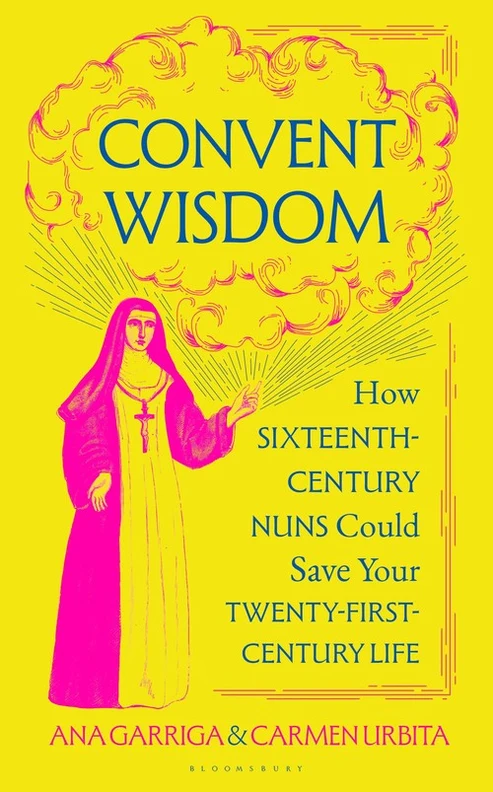
At a time when many readers are drawn to spirituality while remaining wary of organised religion, Convent Wisdom makes the case that nuns are not relics of the past but provocative guides to questions of belonging, desire, and commitment.
In Convent Wisdom, Ana Garriga and Carmen Urbita use humour, historical anecdote, and contemporary cultural references to reveal nuns as complex, socially embedded women whose lives still offer insight into friendship, faith, ambition, and selfhood.
A different view of religious life
Nuns have often been reduced to the outward signs of religious life: habits, cloisters, silence, and separation from the world. Convent Wisdom begins from a different premise, insisting on the rich interior lives, practical intelligence, friendships, ambitions, and contradictions of women who chose, or were placed within, religious communities.
The book belongs to a long tradition of fascination with women religious, from Sor Juana Inés de la Cruz, whose poetry and arguments for women’s education still dazzle, to St Teresa d’Ávila, whose ecstasy was immortalised by Gian Lorenzo Bernini, and Benedetta Carlini, the Italian mystic investigated by the Inquisition.
These nuns were exceptional; paradoxically, there were also many of them in the early modern period. Thinkers, miracle-workers, healers, writers, reformers, and mystics, they were lauded and, at times, persecuted. Their lives continue to attract historians because they reveal both the constraints and the possibilities of religious life.
From podcast to page
Ana Garriga and Carmen Urbita, two academics who met at Brown University, turned their shared love of historical nuns into the podcast Las hijas de Felipe. Its premise — “Everything that is happening to you has happened to someone in the 16th or 17th century” — also animates the book, which pairs stories of nuns with reflections on friendship, queer awakenings, personal struggle, and pop culture.
Nuns for a secular age
The wider culture’s fascination with nuns is not difficult to trace. From Audrey Hepburn to Madonna, from Chappell Roan to TikTok, they remain potent figures of mystery, discipline, refusal, community, and faith in a largely secular world.
This may help explain the book’s appeal to a generation often described as spiritual but not religious: readers who practise yoga or meditation without joining a church, seek meaning in retreats, pilgrimage, therapy, or nature, value ritual and community, yet remain wary of institutional authority or inherited doctrine. Convent Wisdom meets that ambivalence by presenting religious life neither as quaint curiosity nor as simple model, but as a demanding alternative way of organising desire, attention, friendship, and purpose.
Garriga and Urbita develop these themes with wit and clarity. Organised by subject — girlfriends, work, body, love, money, soul, and fame — the book combines historical anecdote, self-help-style reflection, internet culture, modern dating, and pop imagery with surprising ease.
Recovering women’s religious lives
The authors cover an impressive range, especially Spanish-speaking nuns from Spain and its South American colonies who may be unfamiliar to English-language readers. Hildegard of Bingen, Catherine of Siena, and Teresa of Ávila also appear, not as isolated geniuses, but as women embedded in convents,communities, and the wider world.
From love to friendship, money to fame, these early modern nuns emerge as surprisingly relatable, even when their devotion involved fasting, levitation, bilocation, or noisy public weeping. The book’s strength lies in finding their humanity without stripping them from the religious worlds that shaped them.
Theological questions for today
Convent Wisdom also raises timely theological questions: how women exercise spiritual authority, how bodies and desires can be disciplined or sanctified, and what vowed community might offer a culture suspicious of obligation yet hungry for belonging. Its central provocation is not merely that nuns were more human than stereotypes suggest, but that their lives invite modern readers to reconsider freedom, vocation, prayer, and the commitments through which a self is formed.
An Oxford resonance
That argument also has a resonance for this reader in Oxford, where the Sisters of the Love of God at Fairacres live a contemplative Anglican monastic life shaped by prayer, silence, study, hospitality, and daily community. For a reader who serves as their Warden, Convent Wisdom speaks not only to historical or foreign forms of religious life, but also to living communities of commitment, withdrawal, and service.
Conclusion
Convent Wisdom is most compelling when it shows that nuns are not simply figures from a vanished religious past, but witnesses to enduring questions about how lives are ordered, communities sustained, and selves formed.