
Introduction
This reflection builds upon my earlier piece about Terry Frost (https://www.jameswoodward.online/blog/terry-frost-colour-place-and-powerful-spiritual-imagination/) and is part of a series of reflections drawing together my interest in Art and Art Galleries.
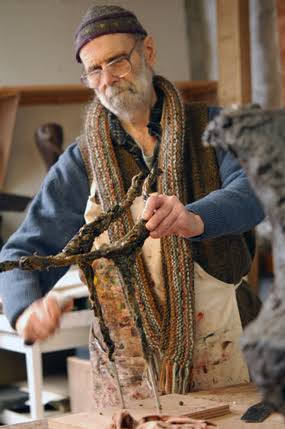
To begin with Breon O’Casey is, for me, to enter one of the quieter rooms of the St Ives story. His paintings and objects ask me to slow down, look again, and allow colour, surface and space to become forms of spiritual attention. In that stillness I recognise something of the contemplative life: the discipline of seeing beneath the surface and waiting for what may be disclosed.
My reflections on Terry Frost offer a helpful contrast. Frost gathers colour, memory and place into a language of movement and delight. His work reminds me that joy is not incidental to theology; it may be one of its deepest registers. In Frost, abstraction becomes praise, and colour becomes a pilgrimage towards gratitude and grace.
O’Casey asks a related but quieter theological question. If Frost gives us exuberance, O’Casey offers restraint. Wood, metal, paint, jewellery and constructed forms become meditations on balance and poise. His work suggests that the holy is often encountered not through excess, but through simplicity, attention and reverence.
Why O’Casey matters
O’Casey matters because he holds together several worlds too often separated. He was painter, sculptor, printmaker, weaver and jewellery maker; his breadth reveals an imagination committed to the dignity of making. In an age of speed and visibility, his practice reminds me that vocation may be patient, various and rooted in the work of the hand.
Within the St Ives tradition, O’Casey absorbed the discipline of form and material, yet developed a quieter vocabulary of his own. His modest signs — birds, animals, figures, circles, triangles and squares — carry a stripped-down symbolic power. Meaning does not need inflation to become profound; even the smallest form, held truthfully, can carry spiritual weight.
Theologically, O’Casey is important because he resists excess. His art waits. It trusts form, silence and material presence. It teaches a way of looking and living that is less hurried, less declarative and more attentive to the grain of things. Faith, too, requires this discipline: to notice, simplify, wait, and discover that the holy may come quietly.
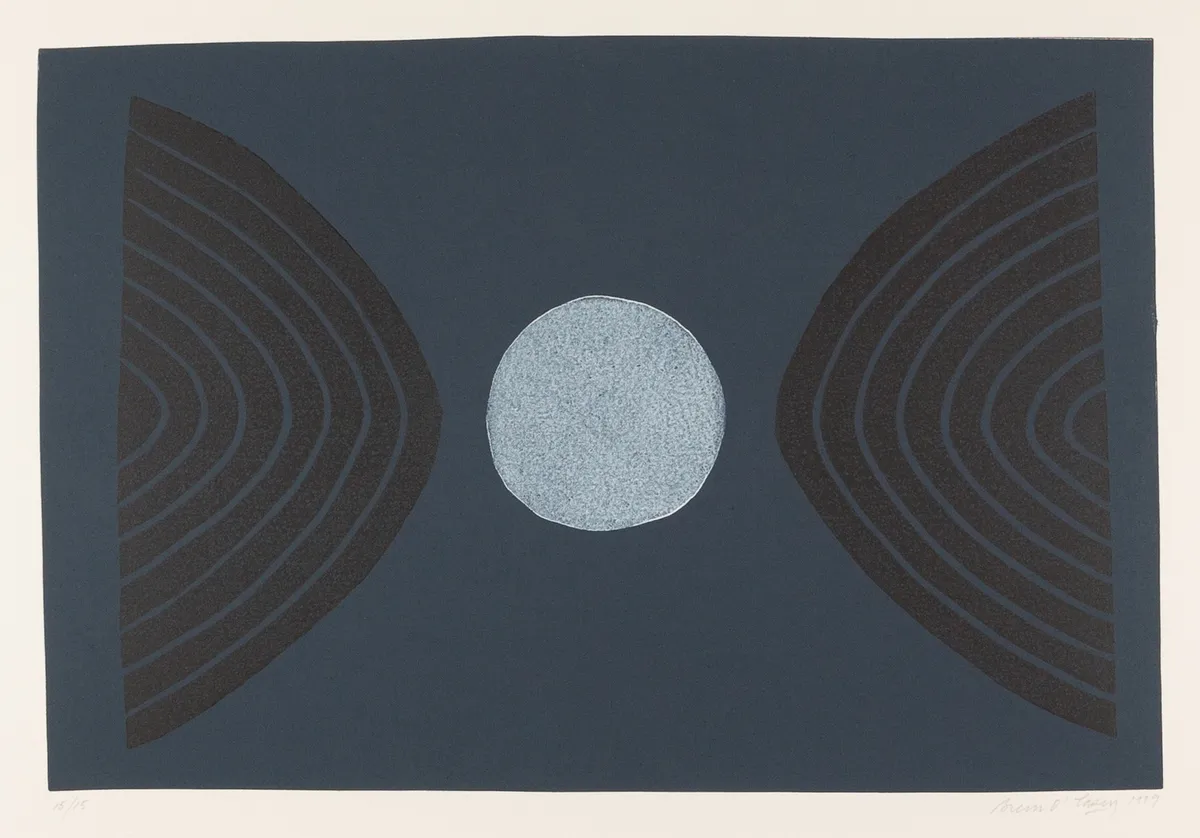
Consider this personal favourite piece of O’Casey Moon 1999
Letting theology find us
What theology helps me to see in these works is that spirit and matter are not enemies. Christianity begins not with escape from the material world, but with the Word made flesh. The incarnation gives dignity to colour, texture, weight, light and form, and tells us that God’s presence may be encountered through the tangible and particular.
The St Ives School is therefore theologically suggestive not because it makes religious art in any narrow sense, but because it opens a religious space. Frost turns joy into doxology; O’Casey turns restraint into reverence. Both remind me that grace may work through form as well as word.
Holding Frost and O’Casey together, I begin to see a theology of pulse: expansion and restraint, praise and contemplation, gift and discipline. Without joy, faith becomes brittle; without restraint, it becomes shallow. These artists help me receive the world gratefully, attend to it patiently, and allow beauty to become a summons towards God.
A personal story of contemplation
I remember a moment of stillness in a quiet gallery space. At first I noticed the usual distractions: muted voices, footsteps, and the restlessness of my own mind. Before me was a work whose surface did not immediately yield its meaning. Nothing dramatic happened, yet as I remained with it my looking changed. I stopped searching for a message and began simply to attend.
That shift felt close to prayer. Contemplation asks me to remain, consent to silence, and let go of the impulse to master what is before me. The artwork became a companion in stillness, teaching me that attention itself can be an act of faith.
Art trains contemplation because it resists haste. It asks for duration, humility and surrender. Abstract work is especially fruitful because it releases me from immediate recognition and invites me to dwell with colour, line, balance, texture and space. In O’Casey, contemplation becomes purification; in Frost, it becomes enlargement. Together, they return faith to the simple miracle of attention.