
de Waal on creativity, vocation, mentorship and failure
I first encountered Edmund De Waal through his spectacular book The White Road which is an account of his travels and exploration into the history of porcelain. It was both informative and illuminating as he took his reader into his discoveries.
I was led to it by seeing his (now) famous white pots at one of my Saturday visits to Roche Court Sculpture Park and Gallery, also known as New Art Centre. There is a collection of his work in the Artists House and the Design House which is a two story building built in the garden. It is still run by the wonderful Madeleine Ponsonby, the Countess of Bessborough, who was a great encourager of the work of Sarum College during my time there. I have happy memories of a visit of Madeleines hospitality to a large group of ministry students during their annual summer school one year. It is well worth a visit. {1} It was also good to hear him speak at Dean Robert Willis’ memorial service in Salisbury Cathedral particularly at the way Robert had encouraged him as a young artist.
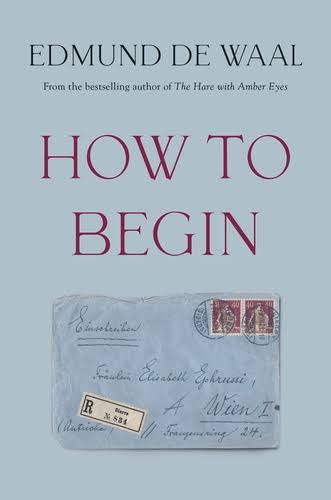
This book is personal.It refelcts on the nature of creativity, vocation, mentorship and failure. Above all de Waal’s shows his reader what it might look and sound like to find their own voice.
This is no ordinary family. We learn about the connections between three generations of his family but in particular through an unexpected relationship: that between de Waal’s grandmother, Elisabeth Ephrussi, and the great German-language poet Rainer Maria Rilke.
I found one of the central questions in this book challenging at this stage of my own journey as I shift through what my own working life has looked like as I step into a new season. The question is this : how does anyone begin to live a creative life?
This is explored through a number of interwoven narratives. De Waals grandmother, Elisabeth Ephrussi, as a young woman studying law in Vienna, also aspired to be a poet. She took the bold step of writing to Rilke. who was one of the most significant poets of his generation. Not only that, she had the courage of sending him some of her own poetry. Rilke replied, and there followed correspondence that lasted for over five years, until Rilke’s death in 1926. We are taken into this exchange of letters, poems, books and translations. A relationship written in ink of two people who never met. What is clear is that it was an exchange and connection that was an important part of the shaping of Elisabeth’s intellectual and emotional life.
De Waal reminds his reader of the importance of ambition and aspiration. He continues to aspire to being both a potter and a poet. and writes about this apprenticeship. It is a journey of learning through failure, accepting criticism, of sustaining some discipline and focus as the craft is mastered. He shows his reader how to navigate the extraordinary complicated line between when to listen to advice and when to disregard it.
We also learn or invited to think about quite a different relationship with time. It may be that his reader is being shown that all us in our various ways need to slow down, listen to advice and having some wisdom about when we should disregard it.
Early reviewers have helpfully identified some key themes. They resonate with this reader as he takes stock of some of his experience of working in the area of ministerial formation at Sarum College over the past eleven years.
- The virtue ofencouragement. Where do we get our encouragement from and who do we encourage?
- The courage to begin! We all need the willingness to begin.
- The importance of mentorship. Who are your mentors ? Where do we turn to for advice ?
- Failure is part of creativity. Life involves us all in the messy business of making mistakes and beginning again
- The need to find one’s own voice – too often we can be imprisoned by others expectations !
- The importance of poetry. Poetry becomes a means of understanding experience, finding consolation and imagining a different kind of life.
- The continuity between generationsThe book is also about memory, family inheritance and the ways in which encouragement and ideas survive long after the people who first expressed them have die.
Perhaps one of the most interesting ideas in this book is that creativity is rarely an entirely solitary achievement. Our voices all too often and sometimes unexpectantly emerge through encounters with people who recognise, encourage, challenge and sometimes unsettle us. {2}
Two final thoughts.
I have spent sometime since I stepped back from full time ministry at Sarum College involved in the privilege of speaking and preaching at two funeral and memorial services of people who have had an enormous shaping effect on my life and ministry. This book took me back to their encouragement, questions and warnings about work, wisdom and our search for truth. Perhaps we need to nurture more time and space for friendships that hold, encourage and warn !
Second we also need communities of poets who can find a different voice to speak into our hopes and fears? I hope that Sarum College can continue to be a community where words and poetry and wisdom for living collide and nurture and challenge. {3}
In the meantime ….. do read this book and ask yourself what its pages might be saying to you.
{1} Do take a virtual tour via the website to get a sense of the space and place https://www.sculpture.uk.com
{2} This process and journey is described with care on de Waals website https://www.edmunddewaal.com/news/how-to-begin?
{3} Do take a look at the work of Sarum College at https://www.sarum.ac.uk